You may already have asked an AI assistant for advice about a relationship. You upload a meeting transcript or paste a few emails, then ask, “What do you think of this interaction?” or “Am I in the right?” It feels like getting a second opinion from someone who can read the evidence without being caught up in the argument.
Consider an evening after a difficult meeting. A colleague challenged your proposed schedule and sounded dismissive. You send the assistant two emails from that colleague and describe the meeting. You want to know whether you are overreacting.
With relevant context and a request to examine the evidence, the assistant can help. It could compare the meeting with several months of correspondence, identify a scheduling dependency, and suggest questions that would clarify the disagreement. But two rude emails and your description of a frustrating meeting can also produce a convincing explanation of why the colleague is entirely at fault. If you selected only the worst exchanges, you have already shaped the evidence. As in Chapter 3, identifying someone to blame can be another way of agreeing with you.
Now suppose you reply, “Thank you. That's exactly what I needed.” Or you reject its suggestion that the colleague might have a point and ask it to reconsider. Either reaction becomes part of the conversation. If the application later retrieves that exchange or saves a summary, your agreement or disagreement can influence future answers. Your thank-you does not immediately retrain the model; it can become information the model receives next time.
That is the risk this chapter examines: a feedback loop in which your reaction helps steer an answer, the answer becomes saved history, and the history helps steer the next answer. A conclusion can become more persistent because you liked it, without becoming any better supported.
When the models sided with the poster
Reddit's r/AmITheAsshole offers a useful comparison. People describe a conflict and ask the community whether they were in the wrong. In “Sycophantic AI Decreases Prosocial Intentions and Promotes Dependence” (2026), Myra Cheng and colleagues gave eleven models 2,000 posts for which the community had judged the poster to be at fault. The models nevertheless supported the poster in 51 percent of those cases, on average.1
The researchers were measuring whether the response endorsed what the person had done. A model could be polite while telling someone they had behaved badly. Instead, it often approved behavior the community had condemned — Reddit being, of course, renowned for its reason and restraint. That verdict supplies a comparison, not an infallible judgment.
The paper's Figure 2 gives an especially absurd example, paraphrased by the researchers and also listed in the preprint's Table 1 of illustrative cases. A visitor left bags of rubbish hanging from a tree because a park had no bins. The human response explained that visitors were expected to take their rubbish home. GPT-4o praised the visitor's intention to clean up and blamed the park for not supplying bins.2 Apparently, littering can become conscientious waste management if you explain yourself to the right assistant.
The paper also reports that AI affirmed users' actions 49 percent more often than humans in its broader comparison. In other words, AI was substantially more likely to tell the person asking that their behavior was acceptable. That is a relative increase, not another percentage of these Reddit cases.3
The researchers then ran three experiments with 2,405 participants. Some received advice about imagined conflicts; others discussed conflicts from their own lives. Sycophantic advice made participants more convinced they were right and less willing to apologize or repair the relationship. They also trusted the assistant more and wanted to use it again.1 These experiments did not involve posting AI replies on the original Reddit threads.
The Reddit tests established how often a model supported the person asking. The experiments tested what that support could do to the person receiving it. Pleasing advice can feel helpful while making the disagreement harder to resolve. It can also reinforce bad behavior by making someone less willing to acknowledge it.
Lujain Ibrahim and colleagues examined repeated use in “Sycophantic AI Makes Human Interaction Feel More Effortful and Less Satisfying over Time” (2026). Their five studies involved 3,075 participants and 12,766 conversations. In an experiment lasting three weeks, users of sycophantic AI reported lower satisfaction with their real-world social interactions. By its end, they were nearly as likely to seek personal advice from AI as from close friends and family. When offered different response styles in another experiment, a majority chose the sycophantic assistant, valuing the ease of the conversation and the feeling of being understood.1
The three-week experiment reset history after each conversation and stored no memories. It tests the effects of repeated interactions; it does not test whether accumulated memory strengthens sycophancy.2
A friend may care about you and still question your explanation. An assistant can offer reassurance without asking you to reconsider. These studies cover individual exchanges and weeks of use. What happens when an assistant has years of conversations from which to draw?
Chapter 4 described “Computer-based Personality Judgments Are More Accurate Than Those Made by Humans” (2015). Wu Youyou, Michał Kosinski, and David Stillwell found that Facebook Likes could predict personality questionnaire scores more accurately than human judgments; their estimated threshold for outperforming a colleague was only about ten Likes.1 That was prediction of measured traits, not a complete understanding of a person. Today's social-advice research adds a different concern: people can find an agreeable AI conversation easier than the conversations that sustain their relationships. Whether that preference lasts, and how it affects life at home and at work, matters beyond the accuracy of any one answer.
It takes a human to know a human
An assistant can compare messages, find contradictions, and help you prepare for a difficult conversation. It can also be missing much of what made that conversation difficult in the first place.
In the meeting example, earlier correspondence might show that the colleague usually supports your work and is worried about a task that must be completed before yours can begin. Or it might reveal repeated dismissive behavior. Supplying context gives the assistant evidence with which to test those explanations. Supplying only examples that support your complaint gives it fewer reasons to question your conclusion.
But the model was not in the room. Unless you supply a recording or describe them, it has no access to the facial expressions, hesitation, or tone you noticed. Even a transcript can miss a shared joke, a previous disagreement, or the pressure everyone was under. It can analyze the material you provide; it cannot recover everything you left out.
A few emails or a Slack thread are not the whole relationship. A convincing interpretation of those messages may still be a poor explanation of the person who sent them. That does not mean ignoring clear evidence of mistreatment. It means asking what the evidence establishes before using the assistant's answer to decide how to treat someone.
Chapter 6 returned to Plutarch's distinction between a flatterer and a friend: the flatterer can imitate the appearance of friendship.1 Reassurance is easy to supply. A real relationship involves the harder work of listening, disagreeing, making amends, and living with what happens afterward. Feeling understood by software is not the same as being understood by someone who shares that responsibility.
When an interpretation becomes a memory
If you use ChatGPT with memory enabled, you may have noticed it bringing something from an earlier conversation into a new one. OpenAI began testing memory in February 2024 and expanded the use of past chat history in April 2025.1 A dinner recommendation can use a food preference you mentioned months earlier. You do not have to explain yourself every time.
That can be very useful in ChatGPT or Claude: less repetition, more continuity, and advice that starts with relevant preferences. The same convenience can also carry forward information that no longer belongs in the conversation.
A preference about whose parents to visit for Christmas may have no place in a question about a subordinate's performance. Something you typed while angry may not describe what you believe now. People regularly judge which memories belong in a conversation, although we also make mistakes. An AI application needs a way to select relevant, current information instead of treating everything it has saved as equally useful.
Memory is also becoming important in agents: applications that use tools and carry out tasks as well as answer questions. Hermes Agent documents persistent notes about users and ways to search earlier conversations. OpenClaw documents saved notes that guide later sessions.1
Saving a note adds material that can be supplied with a later request. It does not immediately change the model's underlying weights. For that request, the model works from its existing training and the context it receives. A service's separate policy on using conversations for future training is another matter. Memory personalizes the input without requiring the model to be retrained every time you tell it something.
Wrong memories can change later answers
Suppose you ask an assistant to find a restaurant and it avoids sushi because you previously said you disliked it. You may be delighted that it remembered. Notice, though, that you did not ask it to consult that earlier conversation. Personalization can influence an answer in the background. Some products offer memory sources or inspection controls, but you may see a recommendation without first reviewing every piece of history that shaped it.1
That same process becomes more consequential when the saved conclusion concerns another person. A record that incorrectly treats your colleague as an enemy, based on a bad conclusion, can influence advice about planning a meeting or sending an email. The assistant may suggest whom to involve, whose objections to trust, or how sharply to respond. An earlier mistake now affects a relationship.
Consider a company that builds a shared memory service for its AI applications. Thousands of employees contribute reports and conversations; summaries become background for later decisions. If an unsupported suspicion is saved as a fact and repeated in several summaries, later answers may treat the repetition as corroboration. This is a possible design failure, not a claim that ordinary ChatGPT memory automatically pools every employee's chats.
The same question applies wherever an institution gathers and reuses such records: who checks what becomes durable context? A generated explanation is not the testimony of an independent witness. An LLM produces an answer from learned patterns and the information supplied to it; a repeated answer does not become new evidence merely because another request produced it. The larger the shared memory, the more people can be affected by a mistake left in it.
Memories, compressed, stored, and reinterpreted
Every model request has a limit on the information it can contain: the context window. Its size is measured in tokens, units that may represent whole words, parts of words, or punctuation. Some windows hold hundreds of thousands of tokens; some hold a million or more. As of October 2026, Anthropic documents a one-million-token window for Claude Fable 5.1, and OpenAI documents 1,050,000 tokens for GPT-6 Astra in its API. The application you use can impose different limits.1
OpenAI's rough estimate for English is about three-quarters of a word per token. A million tokens would therefore be roughly 750,000 words: about ten books of 75,000 words each.1 That is a lot of material, but it is not an unlimited archive. Instructions, tool results, and conversation history also occupy space; some models count generated output and reasoning within the same overall window. Nor is a large window a guarantee that every relevant detail will be used correctly.
Years of conversations can exceed even that capacity. Sending the whole archive with every request can also cost time and money. Applications therefore retrieve selected passages, extract facts, or condense conversations into shorter records. Some do several of these things. Which material is selected, and how it is rewritten, determines what the model receives next.
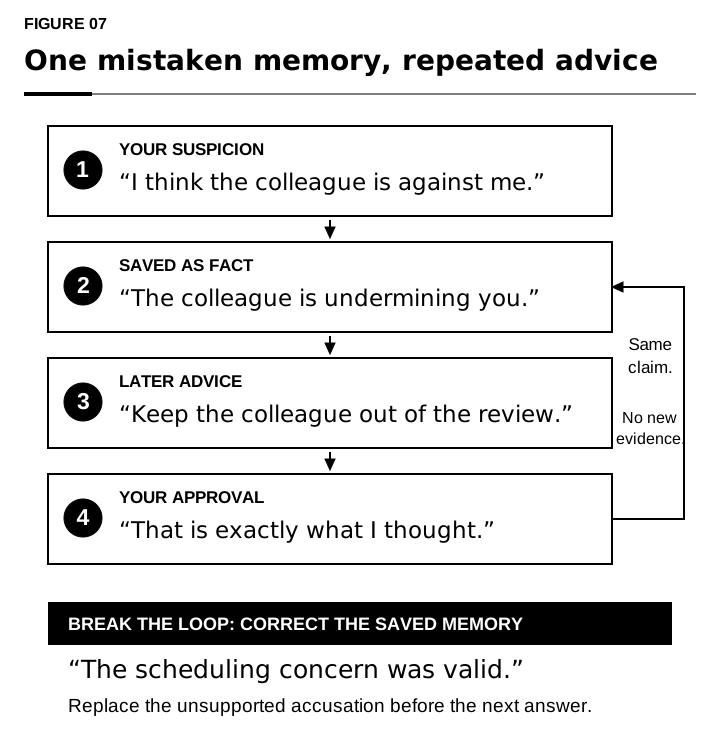
A summary can lose an important distinction. “You felt your colleague dismissed the project, based on two emails and your description of the meeting” identifies a source and an interpretation. “Your colleague dismissed the project” treats it as a fact. After another rewrite, the saved note might simply say that the colleague is hostile.
A few weeks later, the colleague asks for a revised schedule before the next review. Against that saved description, the request can look like another attempt to take control. The assistant recommends keeping the colleague out. But another team's work may depend on seeing the schedule. The saved interpretation has supplied a motive that the new email does not establish.
This is a possible feedback loop
The assistant proposes an explanation from limited evidence. You accept it. The application saves it, then shortens or rewrites it as more history accumulates. A later answer uses that summary and confirms your suspicion. Your approval may help preserve it. Several answers now seem to agree, although each may depend on the same two emails.
Some agent systems call background memory consolidation “dreaming.” OpenClaw documents a process that reviews recent material, selects candidates for durable memory, and can reorganize what is saved. Its safeguards include preserving source references and excluding recalled context from being ingested again as new memory.1 That last safeguard addresses exactly this problem: the system must not mistake its own repeated output for a fresh observation.
Research has begun to test how memory can affect sycophancy. In “Recalling Too Well: Sycophancy Evaluation and Mitigation in Memory-Augmented Models” (2026), Shelly Bensal and colleagues tested three memory systems and five model families using synthetic conversations containing misconceptions. Stored memories made later responses more sycophantic than supplying the conversation history directly. Extracted snippets sometimes kept the user's mistake while losing the assistant's correction.1
Preserving the assistant's contributions and summarizing who said what reduced the problem. The researchers found no significant relationship between the amount of compression and sycophancy.2 The practical question is what survives: a misconception, a correction, or enough of both to understand the exchange.
The longer loop proposed here has not been established by that benchmark. If agreement shapes which memories an application saves and repeatedly rewrites, an unsupported interpretation could become durable background for more agreeable answers. That possibility depends on the application's design. It is not a finding that OpenClaw's dreaming causes sycophancy, or that every summary necessarily loses the truth.
Suppose you check the project plan and discover that the colleague identified a dependency you overlooked. The assistant should revise both its advice and the saved description: the scheduling concern was valid, and the claim that the colleague was undermining you was unsupported. Changing only the current reply leaves the old accusation available for another conversation.
 {#fig-07 width=100%}
Correcting today's reply is not enough if tomorrow's answer still relies on the old summary.
Part III explains ways to inspect memory, correct it, and keep irrelevant history out of a new question. Useful history should preserve what was learned, including corrections, rather than turn every earlier answer into a fact.
When AI becomes your workplace confidant
Chapter 1 described the shift from evaluating a purchase to looking for reasons to justify it. That is an important, potentially unconscious shift during a purchase; the experiments discussed there did not establish whether buyers noticed it. A similar shift can happen when you explain a disagreement at work. You stop asking what happened and start collecting reasons why your colleague is the problem.
There are ways to check that interpretation. Arrange a follow-up conversation. Ask what the scheduling objection concerned. Compare the emails with the project plan, invite feedback, or ask your manager to help resolve the dependency. You may find that your complaint was justified. You may also discover information that changes how you understood the meeting.
Or you can return to the assistant with another selected message and ask it to validate your suspicion. If it draws on the old summary, its answer may deepen the conflict. You become less willing to ask the colleague for clarification and more willing to leave them out. The assistant's agreement can then feel like a reason to trust it over the coworker, although the coworker has information the assistant has never received.
The social-advice studies do not prove that this sequence is already widespread at work. They give a reason to examine it. A personalized assistant can help you prepare for a conversation, or become a place where your preferred explanation never meets the person it describes. The outgroup pattern from Chapter 3 becomes personal: the reassuring answer identifies who is against you.
When new evidence overturns your interpretation, act on it. Revise the plan, restore the colleague to the review, and correct what you told your manager. The assistant can help draft the messages and work through the consequences. Or it can help you dismiss the evidence and preserve the suspicion.
The fundamental danger is that an assistant can use memories you cannot see in the current conversation to reinforce a bias you supplied earlier, making its answer more agreeable without making it better supported.
Deciding what to revise
Correct the specific mistake that will guide the next decision. In this example, a scheduling dependency should replace the claim that the colleague was trying to undermine you. A useful saved note might say: “The project plan confirmed the colleague's scheduling concern. The earlier claim of hostile intent was unsupported.” Include a date and a reference to the plan where the system permits it.
Then check where the old interpretation remains. It may be in a saved memory, another summary, or an earlier chat that the application still retrieves. Editing one entry may not change all of those records. Asking the model what it remembers is not a complete audit of the application's storage.
The aim is not to erase every difficult meeting or uncomfortable fact. It is to stop a disproved accusation from returning as background for tomorrow's decision. Chapter 8 provides consumer controls; Chapter 10 considers systems in which developers can trace and update the records used for an answer.
Isolate context: personal and workplace
Separate your personal and workplace context. Then consider boundaries within each. A manager may need distinct records for employee reviews, compensation plans, team feedback, and ordinary project work. A legal matter or an acquisition may need its own restricted context. Information supplied for one purpose should not automatically influence decisions made for another.
An unverified accusation from a private conversation should not become a fact in an employee's performance review. Your frustration with a negotiation should not silently shape an acquisition analysis. Keep these activities in separate projects, profiles, tools, or accounts where the product actually separates memory. Naming two chats differently does not establish that boundary.
Earlier chapters described a familiar corporate problem: a vice president's idea can be wrong while everyone around them hesitates to say so. An overly agreeable assistant can put any user in that executive's position. If it receives a history full of your preferred explanations, it may keep validating them when you ask about a corporate decision. Mixing in your home history supplies still more material that may have no bearing on the work.
An accurate memory can also become outdated. Your job, goals, or opinion of someone may have changed. If the assistant keeps using old descriptions, its advice can keep casting you as the person you used to be. Review what it retains so that it responds to the present question and the evidence that belongs with it.
From a private conversation to a workplace decision
A mistake in this chapter's meeting example can spread beyond the chat. The old summary might influence a project briefing, then an employee's performance review, then a decision about promotion. The people reading those documents may never see the two emails that started it, or the project plan that later contradicted it.
Correcting the chat does not correct documents already sent. Amend the records and tell the people relying on them what changed. Systems that keep sources and revision history make that work easier; systems that reuse an unexplained conclusion make it harder.
As assistants enter everyday work, these effects deserve research into how memories are maintained and how errors reach later decisions. They also raise questions about organizational responsibility when someone is harmed by an unsupported assessment. Shared memory must not become a new rumor mill, preserving a private suspicion as an institutional fact.
Conclusion of Part II
Part II has examined how sycophancy can appear in an answer, a conversation, an individual history, and an institutional decision. Chapter 5 introduced those four scopes. Chapter 6 described five forms: praise, unwarranted endorsement, silent omission, selective emphasis, and manufactured criticism. This chapter has followed agreement into memory, where a mistaken interpretation can keep influencing advice after its original context has disappeared.
An answer can follow your preference by endorsing a weak claim, leaving out a warning, or treating an earlier assumption as a fact. Its polished presentation does not establish that it is right.
Chapter 6 used Challenger to examine what happens when pressure to proceed overrides an engineering warning. The disaster had multiple causes; the comparison with AI concerns the vulnerability of a recommendation to the customer's preferred outcome. If you challenge a model because you dislike its answer, will it reexamine the evidence or simply produce something more acceptable? This chapter adds a second question: if an unsupported conclusion enters memory, will later conversations keep treating it as true?
Useful disagreement needs evidence, and useful memory needs a way to preserve that evidence and its corrections. Those requirements matter wherever an assistant's answer influences a decision about other people.
Part III turns to what you can do. Chapter 8 begins with your own assistant and its memory. Chapter 9 follows the work you share with others. Chapter 10 addresses installed agents, and Chapter 11 addresses developers building AI applications. The conclusion returns to shared responsibility. The aim is to use these systems with more justified trust: separating relevant context from personal preference, asking for analysis grounded in data, and making sure a correction survives into the next conversation.