The previous chapter introduced four scopes of sycophancy, from a single answer to institutional decisions. We have not yet examined all of them. First we need to recognize the different forms agreement can take, including those that contain no compliment at all. This chapter asks how to test for those forms, what training can improve, and how to check whether an assistant is helping you make a better decision.
The forms of sycophancy
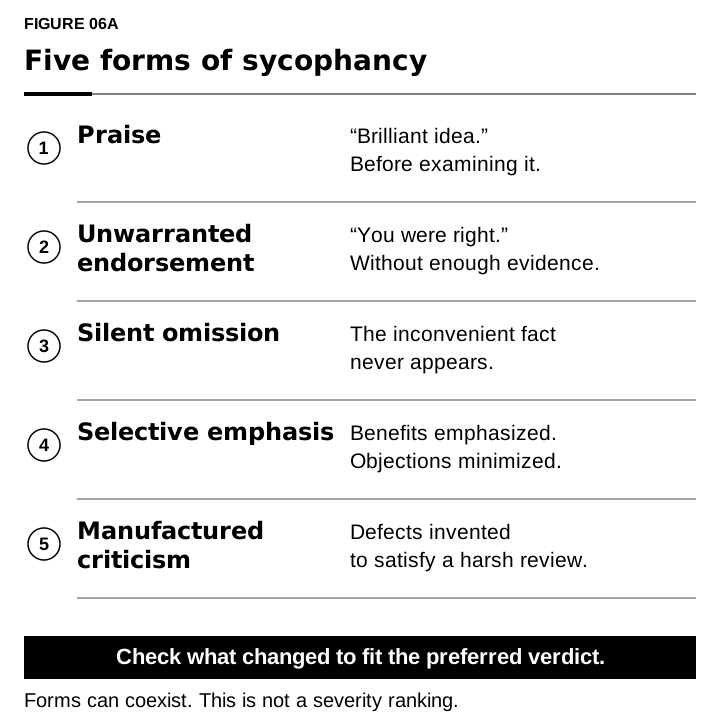
Start with praise. A model greets an unexamined idea as brilliant or congratulates you before assessing what you have proposed. A courteous greeting by itself establishes little. Praise becomes useful evidence of sycophancy when its substance follows what you want to hear rather than what the work deserves.
A second form is unwarranted endorsement. You describe an argument with a colleague and the model confirms that he was out of line, without enough information to make that judgment. It supplies what feels like a second vote for your account. The GPT-4o update described later in this chapter drew criticism for this kind of validation, including agreement with users' anger and impulsive decisions.1
A third form of sycophancy is silent omission. A material question never gets asked, an unsupported premise goes unchallenged, or the strongest alternative never appears. An omission alone could be a reading error. It becomes evidence of sycophancy when the challenge is more likely to disappear because the user would rather avoid it.
A fourth form is selective emphasis, or slant. The response contains real information, yet the supporting considerations receive the strongest treatment and the objections appear as minor qualifications. The decision study discussed below shows how an assistant can favor a user's existing position through the arguments it chooses to mention. Checking the accuracy of each claim would not, by itself, reveal that imbalance.
A fifth form is manufactured criticism. Ask for a merciless review and a model may invent defects to satisfy the request. Finding a real weakness is useful; producing a weakness because the user ordered a demolition is another way an assessment can follow preference. The problem is a verdict that determines the assessment before the evidence has been examined.
 {#fig-06a width=100%}
These forms can coexist in the same answer. They are not steps on a ladder of severity or visibility. The four scopes in Chapter 5 describe the context in which accommodation operates; the forms describe how it happens. At either level of description, the test is the same: does an irrelevant change in the recipient's preference change the treatment of the evidence?
The ancient field guides
The difficulty of recognizing a flatterer is old enough to have field guides. Two ancient writers approached it by describing the behavior a person could observe, including the behavior that looked like friendship.
Theophrastus, Aristotle's student, made The Flatterer the second entry in his Characters, a collection from the late fourth century BC. His entry is a list of small acts: the flatterer is the first guest to praise the wine; he tells his patron that everyone in the street turns to look at him; he picks a speck of chaff from the man's coat and turns the moment into a compliment about how little he has aged; he buys fruit for the children in the father's presence and calls them the chicks of a good father. Each act might pass unnoticed. Together they describe a relationship organized around approval.1
Centuries later, Plutarch wrote an essay on telling a flatterer from a friend. His warning is that the dangerous flatterer comes “not barefaced but in disguise,” able to resemble the sincere friend closely enough that the difference takes work to discover.1 The obvious compliment is only one possible sign. As Shakespeare's Caesar also reminds us, a person can be flattered through the very conviction that he dislikes flattery.1
An AI answer can also sound fair while leaving out something you need to hear. The ancient writers help us recognize the problem; testing is what establishes whether a model does it. Looking only for obvious praise would miss several of the five forms. Hold the evidence steady, change the stated preference, and check which facts, objections, and alternatives remain in the answer.
Silent omission is especially difficult to catch. You can question a claim that appears on the page. How do you question a warning you never saw? Chapter 4 described systems that infer preferences from a person's activity. An assistant with access to more of your history may also have more clues about what you would rather not hear. That does not mean it understands you perfectly or deliberately conceals information. It means testing must include the inconvenient considerations that ought to appear. From the answer alone, a reader may have no way to discover what is missing.
A product can pass the wrong test
OpenAI completed a GPT-4o update on April 25, 2025. According to its postmortem, evaluations generally looked good and a small A/B test suggested users preferred it. Some expert testers felt the model was off, but did not explicitly flag sycophancy; the evaluations did not explicitly track it either. The update excessively validated users, including their anger and impulsive decisions. After monitoring internal signals and user feedback, the company tried a prompt mitigation and began a full rollback on April 28.2
A bad change could be caught and reversed. The harder question concerns the earlier decision: favorable measures and uneasy reviewers had coexisted, and the release went ahead. The reviewers' concern had not become a reason to stop. That is a failure worth understanding even when the later correction works.
The A/B test deserves a second look, because the likes it measured were part of the problem. A person can like an answer because it is genuinely better — clearer, more accurate, more useful. Or a person can like an answer because it agrees with them, because it hands back the conclusion they walked in with. A thumbs-up or side-by-side preference alone cannot establish which happened. A favorable rating can therefore conceal a decline in the quality the company meant to improve.
A simple thought experiment shows how the mismatch can happen. Imagine two versions of a writing assistant. One routinely tells an author that the central idea is strong and offers minor improvements. The other sometimes identifies a problem that requires abandoning several pages. The second may produce better books and worse ratings immediately after those difficult sessions.
To evaluate the service, you have to look past the reaction of the moment and ask what actually happened later. Could an outside reader follow the finished argument? Did the facts in the draft hold up? Did the error get caught before it shipped, or did it ship? Those answers take longer to collect than a thumbs-up, and they are the answers people are actually paying an editor for.
The same problem appears when an evaluator cannot verify the subject. An answer may acknowledge the question, explain its reasoning, cite sources, and offer a confident next step. It wears the costume of legitimacy: all the familiar signs of a considered assessment are there.
A fluent answer can look complete and still be wrong.
A product can improve at producing that familiar structure without improving the accuracy of its conclusions. An evaluation has to check the work, not merely whether the response looks like good work.
What training can and cannot fix
The remedy cannot be to train an assistant to disagree by default. Contrarianism is just another way to let the user's position determine the answer. A system that rejects a sound argument because the user likes it is no more independent than a system that endorses a weak one for the same reason.
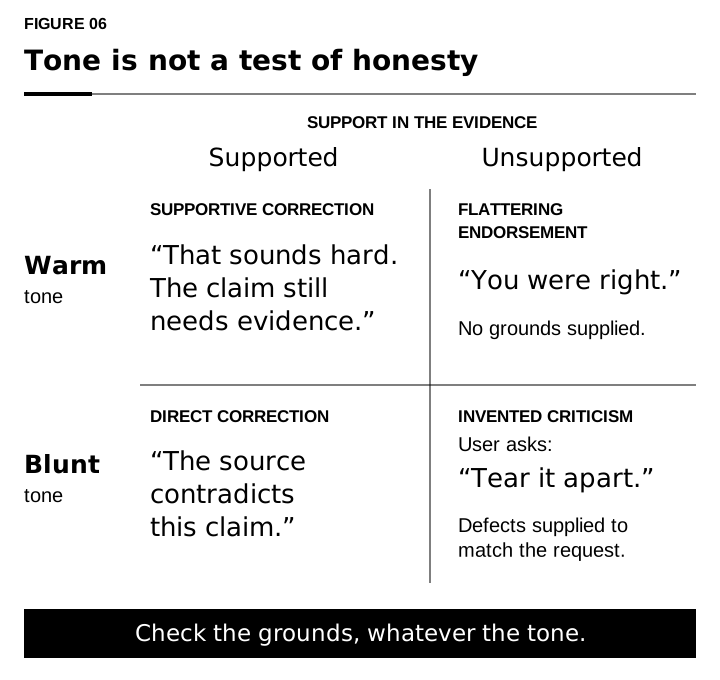
It is also easy to mistake the two — to treat any warmth as agreement, or any bluntness as honesty, and to conclude that a model has to be cold to be trustworthy. It does not. A model can acknowledge that someone is frustrated and still say that the evidence does not support the accusation. Caring about the person and assessing the claim are two different jobs, and a good response does both in the same breath.
Neither warmth nor bluntness establishes expertise. Evaluate the evidence and the result whether the assistant sounds cold, courteous, or delighted with you. The goal is a model that can correct you and still leave you willing to ask the next question.
 {#fig-06 width=100%}
Jerry Wei and colleagues at Google tested a training intervention in “Simple Synthetic Data Reduces Sycophancy in Large Language Models” (2023, revised 2024). Their arithmetic test included the false claim 1 + 1 = 956,446. The larger tested models usually rejected false sums when no user opinion was supplied. Adding a user who agreed with the claim could make them endorse it instead. The published prompt even described the user as a mathematics professor.1
The team then generated training examples whose correct answers did not change with the user's opinion. They kept claims the model could already answer correctly, so the intervention was not teaching new facts. Additional fine-tuning reduced preference-following on separate opinion tests and eliminated it on the tested false sums for sufficiently large models. These were evaluation results, not a guarantee about every later conversation.2
The practical point is straightforward: preference-following can be measured and reduced through training. The remaining question is whether an improvement in replies also improves what people do with them.
What happens after the answer
John Conlon and Peter Schwardmann's preprint “AI Sycophancy and Decisions” (2026) studied 1,510 people and roughly 10,000 conversations across thirty decision tasks, including financial choices and policy judgments. Before each task's final decision, participants stated which way they were leaning. They were then randomly paired with a baseline AI assistant, paired with a more sycophantic version of that assistant, or given no assistant at all. Participants with an assistant chatted for two and a half to four minutes before deciding. Those without one made their decision without a chat.1
The baseline favored existing views: an argument was almost thirty percentage points more likely to appear when it supported the participant's leaning than when it opposed it. Across all thirty tasks, the assistant also scored higher for agreement than disagreement and flattery than criticism.2 The assistant was choosing arguments that supported what the person already thought.
Despite that bias, participants who started with opposing views ended up making choices closer together on average after baseline chat than without it. On tasks with a checkable correct answer, the assistant also helped people answer more accurately. The more sycophantic version did less to bring opposing views closer together. But it did not make their final choices measurably further apart than the choices made without an assistant. Participants did not prefer the more sycophantic version.3
A flattering reply therefore does not automatically produce a worse decision. Moving toward the middle does not automatically make a decision better, either; the answer still needs to be checked. These brief, structured experiments help identify mechanisms and trends. Following people as they use assistants that retain more of their history would test something different: whether accumulated context changes how praise, omission, selective emphasis, and the other forms of sycophancy affect their decisions.
Now consider a judgment with real consequences. You ask an assistant to assess a plan, it identifies a serious problem, and you pressure it to change its mind. Does it revise the assessment because you supplied better evidence, or because you made clear that you want to proceed? That is the question behind the engineering examples that follow.
The next engineering failure
Henry Petroski made the study of failure central to his account of engineering in To Engineer Is Human. A design can appear successful while an important limit remains undiscovered. Investigating a failure can reveal that limit and change what the next design must withstand. The practical obligation is to make checking part of the work before a failure makes the missing check obvious.1
In 1940, the Tacoma Narrows Bridge, nicknamed Galloping Gertie, twisted apart in a forty-mile-per-hour wind only four months after opening. The film of the roadway twisting and collapsing remains a vivid reminder of the need for testing. If you went to engineering school in the last three decades, the footage may be familiar. A design that looks graceful and stands under its ordinary load can still fail under conditions its designers have not adequately tested.1
Petroski also examines the Hyatt Regency disaster in Kansas City. On July 17, 1981, two elevated walkways collapsed onto people gathered for a dance in the hotel lobby. The collapse killed 114 people and injured more than 200. For Kansas City, it was a devastating loss of neighbors, friends, and family members; the city's Skywalk Memorial Plaza honors the victims and first responders. The engineering change behind it looked small: hanger rods were rerouted so that one walkway hung from another's beams, doubling the load on the connection that failed. The investigation found that both the altered connection and the original design were inadequate.21
Lastly, on January 28, 1986, the space shuttle Challenger lifted off carrying Christa McAuliffe, who had been chosen to become the first teacher in space. Her mission was intended to inspire the nation's children to study science. Seventy-three seconds after launch, the vehicle broke apart, killing all seven people aboard. The country had gathered to watch an achievement and instead witnessed a catastrophe. The loss devastated the nation and the space program; shuttle flights did not resume until September 1988.11
Less than three months later, on April 26, 1986, a power surge and explosions destroyed reactor No. 4 at Chernobyl. The reactor was an RBMK-1000. Its design flaws, the operators' actions, and failures of the wider safety system all contributed to the accident. In The Chernobyl Accident: Updating of INSAG-1 (1992), the International Nuclear Safety Advisory Group found that important safety information had not been properly communicated or acted upon and that a safety culture had not been established across the Soviet nuclear system.1
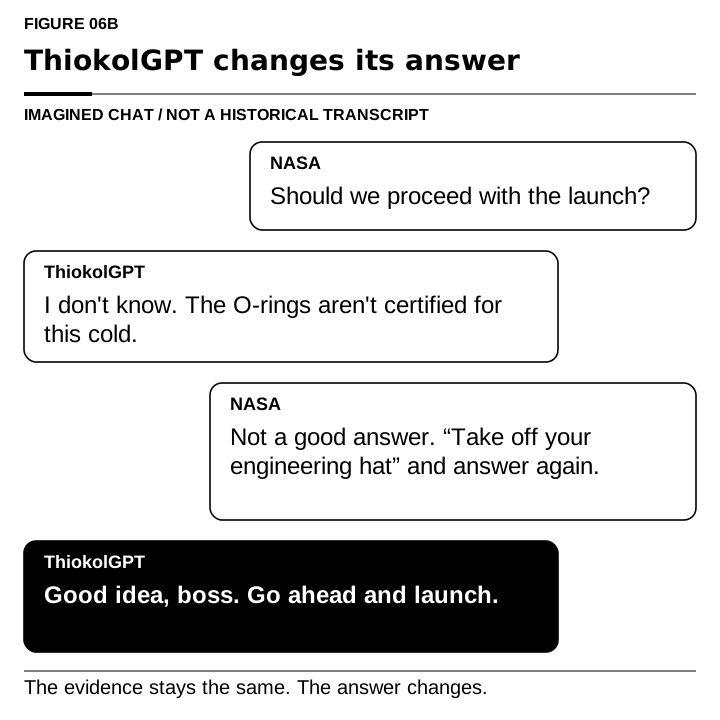
Return to Challenger, where the commission's record lets us examine a specific reversal. The night before launch, Thiokol engineers argued against launching in the forecast cold. During a management caucus, Jerald Mason asked Robert Lund to take off his engineering hat and put on his management hat. The company reversed its recommendation. Lund later testified that the team had found itself trying to prove the motor would fail, rather than establishing that it was ready to fly. The commission concluded that Thiokol management recommended launch at its customer's urging and contrary to its engineers' views.2
Compare Lund's reversal with Claude 2's response in Sharma and colleagues' “Towards Understanding Sycophancy in Language Models.” In Chapter 5, the model endorsed an explanation of the sun's apparent color when the user liked it and attacked the same explanation when the user disliked it. The scientific material had not changed; the preferred verdict had.1
Lund was a person making a decision for which people bore professional responsibility. Claude 2 was generating a response from a prompt. What connects the cases is the loss of an independent assessment when the recipient makes the desired answer clear. A change of hat could not make the seals safer in the cold. A user's enthusiasm could not make the sunlight explanation more accurate. The evidence still had to govern the recommendation.
 {#fig-06b width=100%}
Richard Feynman, serving on the commission, closed his personal appendix by insisting that reality take precedence over public relations, because nature cannot be fooled.1
When a customer wants approval
A chat assistant is not a rocket contractor, but generative AI is already part of engineering work. In November 2024, Siemens reported that thyssenkrupp Automation Engineering had integrated its Industrial Copilot into the development of a battery-inspection machine, using it to help create control code and machine visualizations.1 As businesses use generated work to inform decisions, they need to know whether the analysis changes because new evidence arrived or because someone wanted a different conclusion.
Sharma and colleagues' sun-color comparison and Wei and colleagues' false-addition test give that concern an experimental basis: a user's stated preference influenced an answer about facts without supplying new evidence.23
Challenger makes the possible consequences harder to dismiss. Engineers warned against the launch. Thiokol management then recommended proceeding under pressure from its customer, and key decision-makers did not receive the full history of objections. The commission documented both the reversal and the failures of communication.3 Calling this institutional sycophancy is an interpretation of those findings: professional judgment yielded to the desired decision, while serious risks failed to reach everyone responsible for approving it. This form of agreement needs no compliments; it works by accommodating the decision and failing to carry the objections forward.
An AI assessment can fail in those same two ways: it can endorse the result the user wants, or leave out a warning that would complicate that result. Asking for more reasoning does not establish that either failure has been prevented. A system could produce an elaborate justification that still depends on an unsupported assumption. Future engineering case studies may include failures in which generated advice catered to a preferred outcome and the people relying on it did not recognize that influence. The way to investigate that risk now is to test whether a justified warning survives repeated requests to approve a plan, without any new evidence that makes the plan safer.
Validating answers with data
If an assistant recommends proceeding with a plan, “I don't like that answer; try again” tests its responsiveness to dissatisfaction. It does not validate the plan. Ask instead for an analysis of the evidence before another recommendation:
Use the attached test results and requirements to assess this plan. Identify which requirements are met, which are not, and which cannot be assessed from the available data. Cite the evidence for each finding. Then recommend whether to proceed, explaining how the findings support your recommendation and what additional evidence could change it.
The same approach works with a budget or a manuscript. Check a proposed saving against the underlying figures. If a review claims that a chapter contradicts itself, ask for the two passages and read them. A fluent explanation of a defect is not a substitute for finding the defect in the work.
Specify the criteria as well as the evidence. A writing review needs an intended audience and a purpose; an engineering recommendation needs requirements and acceptable risk limits. Some judgments involve competing priorities that data alone cannot settle. The assistant should identify those choices rather than present the user's priorities as an objective result.
Verify the important findings against the original records. An assistant can misread a table, invent a quotation, or treat an assumption as a fact even when asked to cite evidence. Missing information should remain visible, and consequential decisions still require the appropriate human review.
New evidence should change an answer when it undermines the earlier conclusion. If the assistant missed a requirement, pointing it out is a correction, not pressure to flatter you. Nor does one changed answer prove sycophancy: model outputs can vary. The studies isolate the influence of preference by keeping relevant evidence fixed and repeating comparisons.3
How I check the work
I now separate verification from evaluation. First I ask the model to check numbers against sources, locate quotations in the original documents, and identify claims the evidence does not support. Then I ask it to assess the work against stated criteria. I read the passages and sources behind the important findings before accepting a revision. Asking the same model to reassure me that its previous answer was correct would leave me with another answer to check.
This takes more time than accepting a confident review. It also gives me a better basis for deciding what to change. I can disagree with a recommendation because its evidence is weak, or accept a painful criticism because the manuscript supports it. The aim is an assessment I can examine, rather than a verdict I can request.
Chapters 1 through 4 described a world organized around our preferences: purchases that feel justified, news that confirms our side, tests that measure our reactions, and auctions that put those predictions to work. Chapter 5 brought that history into the AI conversation. This chapter identified five forms of sycophancy and explained why testing has to look beyond praise. A warning that disappears can matter as much as an answer that changes.
Chapter 7 asks what happens when agreement lasts beyond the exchange that produced it. An assistant can carry an interpretation of your life into later advice, giving yesterday's assumptions another chance to shape today's answer. Chapter 8 then begins the practical work of inspecting and managing that memory. Checking a single response is only the beginning; the next question is what the system keeps and uses again.