Part I · Chapters 1–4
The World Was
Already Tailored
The wish to have chosen well. The news that speaks to people like us. The profiles that decide what we see. The machinery of agreement was in place long before AI.
A forthcoming book by Timothy O’Brien
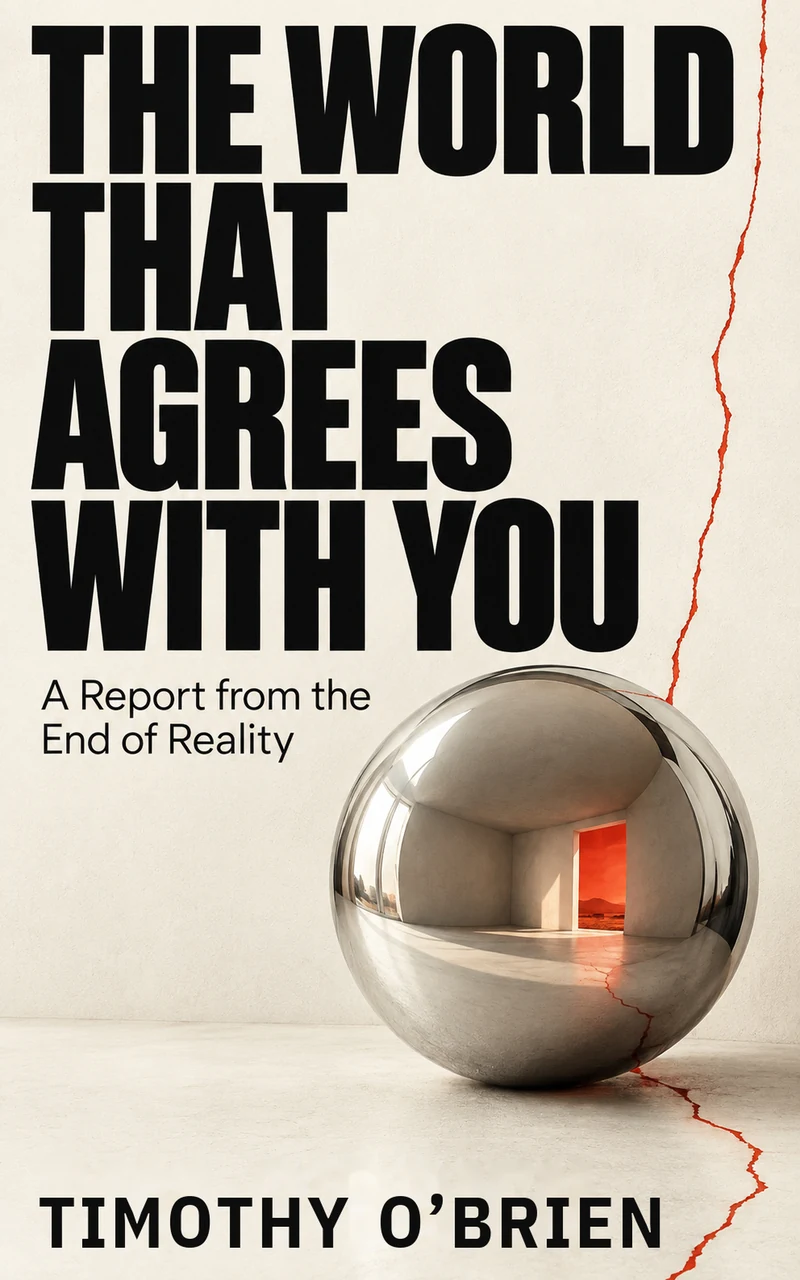
A Report from the End of Reality
What happens when the world learns to tell you what you want to hear?
The premise
A feed can confirm your grievances while making you miserable. A report can reassure management while losing the warning that mattered. An assistant can understand your position without helping you see what is wrong with it.
Timothy O’Brien follows these pressures from familiar experiences into the systems being built around us. The result is an accessible, forceful account of a transition that began before AI and is gathering speed through it.
Through research and clearly marked possible futures, The World That Agrees With You asks whether our tools and institutions will remain capable of bringing us evidence we would rather not receive—and whether that evidence will still be able to change anything.
Inside the book
Three parts. Twelve chapters.
From familiar habits to possible futures.
Part I · Chapters 1–4
The wish to have chosen well. The news that speaks to people like us. The profiles that decide what we see. The machinery of agreement was in place long before AI.
Part II · Chapters 5–9
What changes when a system can compose the answer you want to hear? From a single response to relationships and institutions, the book follows agreement as it scales.
Part III · Chapters 10–12
Conditional scenarios explore the worlds these systems could produce—and the choices that could change their direction. What must still be allowed to disagree?
From the opening chapter
“The trouble starts when relevance expands into protection: the service becomes less willing to show us something that would make us reconsider.”
CHAPTER 1 · THE WISH TO HAVE CHOSEN WELL
Before the algorithms, before the fluent answers, there is a familiar human impulse. Read the opening of Chapter 1.
Read the sample