Many people try to protect their privacy online by refusing tracking cookies. Visit a website for the first time and you may be asked to accept or reject them. Cookies are small records stored by your browser; a website can use them to recognize a returning visitor. These prompts respond to privacy rules, including requirements in the UK and EU to obtain consent for many forms of tracking.1
Choosing “reject” can limit cookie-based tracking. It does not guarantee that the website cannot recognize you. To send you a page, the server receives an IP address: the network address through which your request arrives. That address can help connect requests, although several people may share it and it can change. Your browser and device can also reveal details such as browser version, screen settings, and fonts. Combined, these characteristics can form a fingerprint that helps distinguish your browser from others. If a tracking company collects a matching fingerprint on two websites, it may connect those visits without a tracking cookie.11
These techniques are subject to privacy rules, too; avoiding cookies does not automatically remove consent requirements. Refusing tracking still matters, but it does not erase earlier observations or every other means of recognition. A login may connect activity to your account, and a company may already hold your purchase history. The question is how these observations become a record that can follow you from one encounter to the next.2
The effort is not new. The FTC’s Online Profiling: A Report to Congress (June 2000) described advertising networks connecting visits across unrelated websites and combining those observations with sources such as offline purchases. A person did not have to click an advertisement for their activity to contribute to the profile used to select the next one.1
By 2014, the FTC's investigation of nine data brokers documented holdings covering nearly every U.S. consumer. Sources included purchase records, browsing activity, and warranty registrations. Brokers combined information and inferred interests and characteristics from it. Seven of the nine bought information from or sold it to one another. One held more than 700 billion aggregated data elements.1
There is no single profile of you waiting in one central database. Retailers, publishers, advertising companies, and brokers can hold overlapping records, each assembled for a different purpose. Your browsing and purchases can supply new observations throughout the day; other records arrive in batches. The FTC found that brokers' sources supplied updates on schedules ranging from real time and daily to much longer intervals. Some brokers waited before incorporating those updates into their own files.2 Refusing tracking on one website does not erase records held elsewhere. Third parties you have never dealt with directly may still use information they already hold when deciding which offer to put in front of you.
The machinery of recognition
A system needs some way to connect an observation with an earlier record: that the person viewing this page is the person who searched for a term this morning or bought a brand of coffee last month. Your name is one possible connection. An advertising identifier, an email address, or an account login is another. Distinctive technical details can sometimes do the work too.
In “How Unique Is Your Web Browser?” (2010), Peter Eckersley of the Electronic Frontier Foundation found that among 470,161 volunteer browsers, 83.6 percent had a combination of version, screen settings, fonts, and plugins unique within that sample. The finding demonstrated how distinctive ordinary browser configurations could be. It describes that historical sample, not permanent identification of everyone using a browser.2
In “Online Tracking: A 1-million-site Measurement and Analysis” (2016), Steven Englehardt and Arvind Narayanan crawled the top one million websites. They documented cookie-based tracking, exchanges connecting parties’ different cookie identifiers, and several fingerprinting techniques deployed on real sites.2 A company could use several methods to connect visits, so blocking cookies did not necessarily prevent recognition.
The machinery of an instant
Open an article on a news website that carries advertisements. The publisher supplies the article, but the spaces around it may be filled separately: a banner beside the text, an advertisement between paragraphs, or a video farther down the page. Understanding how those spaces are filled helps explain how the site makes money. Many are sold through real-time bidding, or RTB, while the page is loading.1
An intermediary sends a request to prospective buyers: here is an opportunity to show an advertisement. Each buyer's software evaluates the page, the available information about the visitor, and the likelihood of a useful response, then decides what to bid. The auction selects an advertisement to fill the space. Google's Authorized Buyers documentation specifies bid-response deadlines ranging from 80 to 1,000 milliseconds, depending on the auction. A 100-millisecond deadline is just one-tenth of a second.2 The amount of work that can happen in that interval is impressive: several companies can consult records, calculate a bid, and respond before you have begun reading.
The process can repeat several times on one page. As you scroll down a story, another advertisement may be requested for a space you have not reached yet. Publishers can delay requests until an ad space approaches the visible part of the page, or request new bids as more spaces appear.1 Where a site records browsing activity, observations from before that scroll can inform its next choice. Mouse movements and time on a page can contribute to estimates of attention, although that does not mean every auction receives a stream of your mouse coordinates.1 This is the level of detail at which some websites sell access to your attention to help fund their content. Similar bidding systems operate inside mobile apps.3
The bid-request format is written down. OpenRTB, maintained by the IAB Technology Laboratory, specifies fields an exchange can send to buyers. Its 2016 version includes device details, advertising identifiers, IP addresses, location, and audience segments. A worked example includes “auto intenders” and “auto enthusiasts.” These are permitted fields; not every request carries all of them. Reading the standard makes the transaction concrete: this is the sort of information software can exchange in a fraction of a second to decide what you will be shown.4
In 2022, the Irish Council for Civil Liberties estimated 178 trillion RTB data broadcasts per year across the United States and Europe, using industry data. Its estimated daily averages were 747 broadcasts per person in the United States and 376 in Europe.1
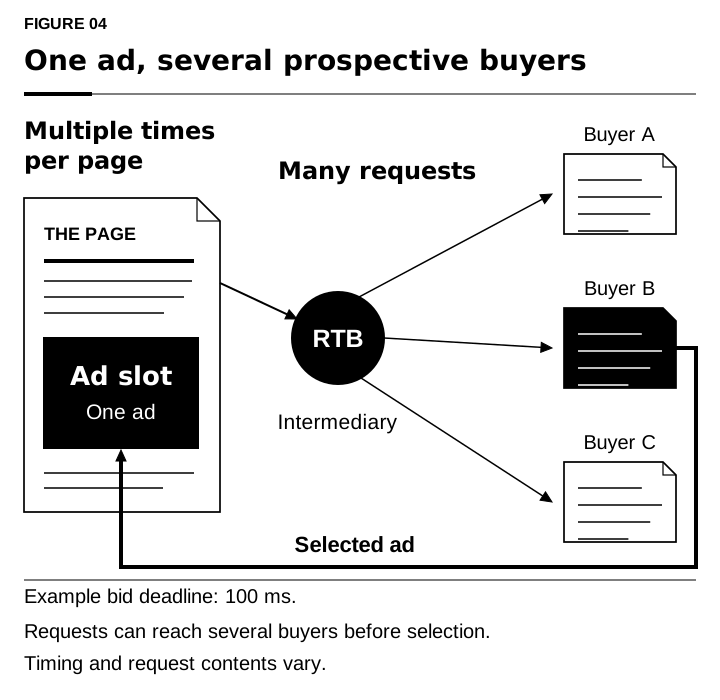 {#fig-04 width=100%}
Prediction can help the person browsing, too. Chrome and websites can preload likely destinations, reducing the wait after a click.1 An advertisement might show you the gift you need for a family member’s birthday. Those benefits help explain why people accept personalization. The same observations that make it useful can also support detailed classifications of the buyer.
Knowing you better than the people who love you
Repeated observations can reveal more than the next product you might want. To see how much ordinary digital activity can disclose, consider research that asked models to estimate personal characteristics from Facebook Likes. The information was much less extensive than the records a service might accumulate across years of use.
Michał Kosinski, David Stillwell, and Thore Graepel studied 58,466 volunteers in “Private Traits and Attributes Are Predictable from Digital Records of Human Behavior” (2013). Volunteers supplied Facebook Likes, demographic information, and questionnaire responses. Models using Likes predicted attributes including political views, religion, and personality, with accuracy varying by attribute.1 A record of things people liked could disclose characteristics they had never expressly stated in that record.
In “Computer-based Personality Judgments Are More Accurate Than Those Made by Humans” (2015), Wu Youyou, Kosinski, and Stillwell compared models with human judgments. Volunteers completed a 100-question personality test. Models trained on other participants' Likes estimated their scores on five personality traits; Facebook friends rated them using a shorter questionnaire. The researchers also compared model accuracy with earlier research on colleagues, friends, family, and spouses. Estimated thresholds were about ten Likes to outperform a colleague, seventy for a friend or roommate, 150 for a family member, and 300 for a spouse.1
“Outperform” meant closer agreement with the person's own questionnaire scores. This was a research comparison of personality ratings, not a test of whether an advertising network understood a whole life. Even with that limit, the result is striking: a relatively small record could support predictions as accurate as, or more accurate than, those made by people who knew the participant.
What the profile assumes
The assumptions become more consequential when they follow a person into decisions. The FTC's 2014 investigation documented brokers selling segments such as "Expectant Parent," "Diabetes Interest," and "Cholesterol Focus," alongside categories combining demographic and economic characteristics. The commission noted that consumers might tolerate categories used for coupons while objecting to their use in decisions about credit, insurance, or employment. An interest in diabetes information, for example, could be read as a sign of insurance risk.1
The report also discussed Spokeo, which the FTC alleged had assembled profiles from online and offline sources and marketed them to human resources departments for use in hiring. Spokeo settled the case. In the commission's analysis, an important distinction was the purpose for which data was used: eligibility decisions could bring obligations under the Fair Credit Reporting Act that did not generally apply to ordinary marketing uses.2
Reading an article about diabetes does not mean you have diabetes. You might be researching a family member's condition or doing your job. But a category such as “Diabetes Interest” may preserve only the interest, leaving a later customer of the data to make an assumption about your health. The FTC's concern was that information useful for one purpose could be interpreted differently for another, without consumers knowing which categories described them or how those categories were used.3 A browsing history is evidence of what someone viewed, not a diagnosis.
The world already agrees with you
The preceding chapters followed reassurance about a purchase, news that confirms a political position, and tests of what brings an audience back. Profiling and rapid delivery let businesses act on those responses repeatedly, for smaller groups and sometimes individual users. An ad auction fills advertising space; it does not itself choose the article. News feeds and advertising systems make different choices, but both can benefit from learning what keeps your attention.
A conversational assistant adds the ability to compose a response. Describe a business plan or a difficult meeting and it can supply an explanation that makes your judgment sound wise. Your objections can then help shape the next answer. The assistant does not need an advertising profile to find out what you prefer; “I think I handled that well. What do you think?” may supply enough direction.
Accommodation becomes sycophancy when pleasing you takes priority over sound judgment. Training and feedback can favor preferred answers, including endorsement of views without sufficient grounds.1 The commercial history helps explain why approval has value. Generative AI can now provide it in a conversation.
Part II examines how an assistant can endorse an answer, validate a view of yourself, or remember an explanation that needs correction. A world that has learned to select what you want to see can now supply a response that says what you want to hear. The practical chapters will show how to question that response and improve the context behind the next one.