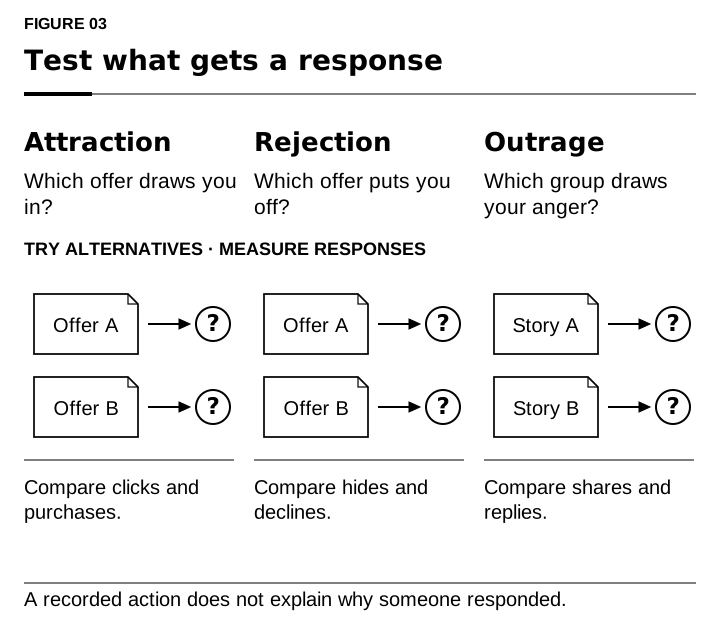
The previous chapter described news businesses serving audiences with particular beliefs. A digital service can go further: it can test what gets a response. Which offer makes you click? Which one makes you leave? Whose success do you welcome, and whose failure makes you want to share the story? Learning what you reject can be as useful as learning what you want. Together, those responses help a service choose what to show you next.
Every response is part of the test
Suppose you spend an evening looking into growing vegetables in a small yard. You read a few articles, watch a demonstration, compare gardening tools, and close the laptop. If you browsed a retailer's site while logged in, it may connect the tools you viewed to your account. Later, an email arrives: those tools are on sale, but only today.1
An invisible 1-by-1-pixel image can notify the sender when your email app loads it. That can be counted as an open, although blocked or preloaded images make it an unreliable measure of whether you read the offer. Click through, and the retailer can record which link you chose. Website tracking can use scrolling and time on a page to estimate where your attention lingered. These signals help decide what to offer next.1
The retailer can compare a discount with a reminder, or try different descriptions of the same tools. A website or app can assign different versions to groups of users and compare the results. Repeated tests help it learn which messages produce purchases and which are followed by people leaving. This is the purpose of A/B testing: compare alternatives against a chosen result, rather than assume that an appealing message works.1
The unwanted response matters, too. An offer might attract clicks while costing newsletter subscribers. A lower price might increase sales while an aggressive deadline puts customers off. Measuring only purchases would miss those costs. A service can record explicit rejection as well: YouTube says dislikes, “Not interested,” and “Don't recommend channel” help inform what it avoids recommending.1
Personalization has real benefits. Remembering your interests, language, accessibility needs, and previous choices can make technology easier to use. Testing can reveal when an offer is irrelevant or an interface is frustrating. The question is whose result the service is trying to improve. You want to grow tomatoes. It may be measuring how often you return or buy.
Does advertising really work?
A test needs a clear question. Did more people buy because they saw the gardening offer, or did the retailer find people who were going to buy anyway? Did matching the message to their interests improve the result? The answers require comparisons with another message or no advertisement, rather than a sales total alone.
In “Psychological Targeting as an Effective Approach to Digital Mass Persuasion” (2017), Sandra Matz and colleagues tested psychologically matched advertising in field campaigns. They reported better click and purchase responses when appeals fit the target group's inferred characteristics.1
Dean Eckles, Brett Gordon, and Garrett Johnson challenged that interpretation in “Field Studies of Psychologically Targeted Ads Face Threats to Internal Validity” (2018). Advertising platforms optimize delivery, so different versions may reach different populations; who receives the message can affect the result.1 Matz and colleagues disputed whether that explanation accounted for their findings.1 The exchange shows why comparing results requires care about what else changed.
Testing is broader than proving a sale was caused by an ad. A service can compare what attracts customers, what they decline, and what makes them return. Those results can improve its predictions even when the reason for a response remains uncertain. Ignoring an offer does not prove you dislike the product; you may have been busy. Staying to argue about a story does not mean you like the person it describes. What the system measures matters as much as which version performs better.
 {#fig-03 width=100%}
Testing who you are and who you are not
Gardening tools are the positive case: find something you want and learn how to sell it to you. The same effort to measure responses can identify what makes you angry. A publisher can compare reactions to stories praising a group you identify with and stories condemning a group you dislike. Both can attract your attention. Identifying who you do not want to be associated with can be as valuable commercially as identifying where you belong.
There are at least two ways to flatter a person. You can tell them they are wonderful. Or, you can tell them they are right about how awful someone else is. This helps explain why a highly personalized environment can also feel so unpleasant. The news websites in the previous chapter can leave readers furious while continually confirming their beliefs. Anger at another group can still be a response that brings you back.
Steve Rathje, Jay Van Bavel, and Sander van der Linden examined political and news posts on Facebook and Twitter in “Out-Group Animosity Drives Engagement on Social Media” (2021). Posts referring to political opponents were especially likely to be shared or retweeted. This was an observational finding about responses, rather than a test establishing that an algorithm caused them.1
There are two different responses here. Rejecting a video tells the service you want less of that content. Sharing a video because it condemns people you dislike may tell the service you want more. Learning your dislikes does not always mean removing unpleasant material. It can mean learning which unpleasant material holds your attention.
William Brady and colleagues examined this feedback in “How Social Learning Amplifies Moral Outrage Expression in Online Social Networks” (2021). Observations of Twitter and controlled experiments showed that social rewards and group norms could encourage later expressions of outrage. They measured expression, not private belief.1 The audience's response can teach a creator what to produce next, just as it can inform a service's next recommendation.
The O'Reilly experience in Chapter 2 illustrates how that feedback can influence a reporter's choice of stories.
Learning which grievance brings you back
Appeals to group identity are much older than automated testing. In “Enemies According to The Friend of the People, or Categorisation of Identity by Contrast” (2002), Agnès Steuckardt examined Jean-Paul Marat's newspaper during the French Revolution. Labels such as “enemies of the revolution” and “counter-revolutionaries” defined opponents and, by contrast, the people on Marat's side.1 Repeated labels can encourage readers to judge a whole group through the faults of its members. A present-day story about a president, a member of Congress, or a British MP can offer similar reassurance: you were right to distrust those people.
A digital service can make those judgments about attention more quickly and for smaller audiences. It can compare which targets of anger attract responses and which leave people uninterested. Outrage can be justified: corruption and abuses of power deserve investigation. The commercial problem arises when keeping a grievance alive helps keep an audience. A correction may weaken the story people return to hear, while another accusation gives them a reason to stay.
Learning which reaction attracts attention is different from proving that it changes beliefs. In “Like-Minded Sources on Facebook Are Prevalent but Not Polarizing” (2023), Brendan Nyhan and colleagues reduced posts from sources sharing the political views of 23,377 Facebook users by about one-third during the 2020 U.S. election. Despite changed feeds and less uncivil language, they detected no change over three months in the political attitudes they measured, including polarization and belief in false claims.1 The lasting effects of a feed change depend on the intervention and setting. A service can learn what keeps an audience active even when the tested changes do not alter its political attitudes.
Campaigns can use testing in the same way, choosing different messages for different audiences. In “Quantifying the Potential Persuasive Returns to Political Microtargeting” (2023), Ben Tappin and colleagues found advantages for tailoring in some policy-message comparisons. Those depended on the policy and alternative strategy; the experiments measured expressed attitudes, not votes.1 Reassuring existing supporters that they chose correctly is another reason to tailor a message, even without winning someone over.
The foundations of real-time sycophancy
Chapter 1 began with wanting reassurance that you made the right choice. Chapter 2 followed that desire into news that confirms you are on the right side. Testing adds a way to refine the reassurance: compare responses, learn what you welcome and reject, and adjust what comes next. A picture of your preferences includes the groups you admire and the groups you want to distance yourself from.
Testing gives a service a way to learn whether praise keeps you interested, disagreement makes you leave, or condemning someone else brings you back. Those responses reveal what holds your attention. They do not establish which judgment is sound. The risk of real-time sycophancy arises when a system uses that feedback to favor reassurance over a warranted correction. It can become better at keeping you engaged without becoming better at helping you decide.
The next chapter follows that record into the advertising auction. While a page loads, buyers can bid for the chance to put their message in front of you. Testing helps them decide which message to offer; recognition helps them connect the opportunity to what they already know about you.