The wish to have chosen well extends beyond a purchase. We also want reassurance that our political beliefs make sense, and news organizations have long understood how to provide it.
Often you can anticipate a story's treatment of an event from the news organization's name. Add a headline and you may feel you already know what the article says, before you have read a word of the reporting.
Shanto Iyengar and Kyu Hahn tested the influence of those names in “Red Media, Blue Media: Evidence of Ideological Selectivity in Media Use” (2009). Participants chose among news reports carrying different source labels. Republicans and conservatives favored material attributed to Fox News; Democrats and liberals favored CNN and NPR. The sorting appeared even for less overtly political subjects, including travel. A familiar outlet's name could influence which story someone selected before they read the reporting.1
Political news audiences exist elsewhere, too. Richard Fletcher, Nic Newman, and Anne Schulz’s “A Mile Wide, an Inch Deep: Online News and Media Use in the 2019 UK General Election” (2020) found that Labour and Conservative voters favored different outlets, alongside substantial use of other sources, especially the BBC.1 In India, Vibhor Agarwal and colleagues’ “Under the Spotlight: Web Tracking in Indian Partisan News Websites” (2021) classified 103 outlets by political leaning before examining their tracking practices.1 The studies address different questions, but both describe markets with recognizable political news identities.
Calling this a reader preference misses half the relationship. News organizations also develop coverage that reinforces the beliefs of the people they attract. As Chapter 1 showed, we often give supporting information a warmer reception than evidence that challenges us. A publication can build a business around that welcome, until the reader's preference and the outlet's coverage reinforce each other.
Knowing a news organization's record can help you decide where to look for reliable reporting. But its reputation cannot do the reading for you. The familiar name becomes a problem when it lets a reader stop asking basic questions: What evidence supports this report? Who was asked? What important context is missing? A trusted outlet still needs to earn your confidence in each story.
For a news business, a recognizable political identity helps establish an audience likely to return. Readers expect to find the coverage they came for, from a perspective they recognize. That relationship can support valuable reporting, but it can also limit what the outlet is willing to report. A finding that unsettles the group's beliefs risks unsettling the relationship that keeps the publication in business.
An old arrangement
The word partisan means committed to a party, faction, or cause. English borrowed it from French, which had borrowed it from the Italian partigiano, a member of a faction, derived from parte, meaning a part or party. The word's history begins with belonging to a side.1
Newspapers organized around political sides are almost as old as the United States. In 1791, Philip Freneau began publishing the National Gazette in Philadelphia, encouraged by Thomas Jefferson and James Madison as a counterweight to the Federalist Gazette of the United States, which supported the Washington administration. Each paper promoted a different political faction. Americans were choosing news by politics before their political parties were fully formed.1
France had its own competing political press during the French Revolution. Jean-Paul Marat's L'Ami du peuple promoted his revolutionary convictions, while the royalist Les Actes des Apôtres began in 1789 and continued into 1792. The fight over France's future took place in newspapers as well as assemblies and streets. Readers could turn to publications that supported opposing answers to the same political questions.1
It is easy to read that history and conclude that partisan news is always a bad thing. But a publication may take a side because an important viewpoint is being ignored or misrepresented. A separate newspaper can make room for people whom the established press refuses to hear.
That was part of the reason Freedom's Journal, the first African American newspaper in the United States, began publication in 1827. Its editors challenged racist representations and gave Black Americans a means of speaking for themselves.1 Serving a distinct audience helped bring neglected experiences into public view. It expanded what readers could know.
The existence of a political identity or a particular constituency does not establish the quality of the journalism. The more useful question is what the publication does when its reporting uncovers something its readers would rather not hear.
Distribution finds its audiences
American network news once made a point of addressing a broad audience. Walter Cronkite made objectivity central to his work.1 The networks did not always meet that ideal, but reporting fairly across political differences was an explicit ambition.
At the beginning of the 1980s, many households still organized their news habits around the newspaper's delivery and the evening television broadcast. Cable created more channels and more hours in which to reach smaller, more specific audiences. CNN's launch in 1980 made television news available around the clock; MSNBC and Fox News launched in 1996.11 The identities familiar to later viewers did not all arrive fully formed. By 2009, Pew Research Center's “Partisanship and Cable News Audiences” documented clear differences in the political composition of the channels' audiences.1 A channel could acquire a political identity through its programming, its audience, or both, regardless of how it described its ambitions.
The World Wide Web expanded that choice again. By the end of the 1990s, people with internet access could check the sites they preferred throughout the day instead of waiting for delivery or a scheduled broadcast. A publisher no longer needed a printing press or a cable channel to reach a specialized audience, and readers could move directly to the subjects they cared about.
Aggregators gave publishers new routes to readers while reducing their control over how stories reached them. At the Senate’s 2009 hearing, “The Future of Journalism,” Google’s Marissa Mayer described automated news ranking; former Baltimore Sun reporter David Simon warned that aggregators were drawing readers away from the publications producing the reporting.1
Facebook's News Feed, launched in 2006, took another step. By 2016, Facebook described a feed that ranked stories by personal relevance, learned from a person's actions, and adapted over time.1 You could still choose a publication, but the feed also chose stories for you, mixing sources according to its estimate of what would hold your attention.
News feeds the conversation
In January 2018, Facebook announced that it would prioritize posts predicted to produce conversations and interactions between friends. It warned publishers that reach and referral traffic could decline, depending partly on how people interacted with their posts.1 News that prompted comments and sharing had a better chance of reaching an audience. An argument could produce those responses too, even though a count of reactions could not tell Facebook whether the story helped anyone understand the event.
News had become something people reacted to together in a feed. A story could spread because it was important, but it could also spread because it gave people something to celebrate, condemn, or fight about. Every new share could bring more views and more opportunities to show advertisements. The conversation itself had become part of the commercial value of the news.
Audience influence was not limited to social platforms. In “What Drives Media Slant? Evidence From U.S. Daily Newspapers” (2010), Matthew Gentzkow and Jesse Shapiro compared newspaper language with phrases used by members of Congress. They found that audience demand helped explain differences in the newspapers' political slant.1 The study measured phrasing rather than factual accuracy, but it makes the relationship clear: the preferences of readers helped shape what publishers supplied.
“How do we keep this audience?”
Consider a small publication that attracts readers by covering a neglected issue well. Subscriptions pay for more reporting, writers become known for their views, and readers come to expect a particular treatment of the subject. Then a reporter finds something that complicates those views. Publishing it is part of the job, but it may also disappoint the customers who made that job possible.
The pressure need not arrive as an order to suppress the story. An editor can give it less space, wait for another source, or put it behind a story readers are more likely to welcome. Those can be reasonable decisions. But if stories that challenge the audience repeatedly receive less attention, the publication is gradually teaching its readers that their existing beliefs explain every new event.
Credibility, rigor, and an editor's pride in doing good work can resist that pressure. During the 2010s, increasingly detailed tracking made the competing commercial pressure hard to miss. In “Between Creative and Quantified Audiences: Web Metrics and Changing Patterns of Newswork in Local US Newsrooms” (2011), C. W. Anderson examined how audience measurement was becoming part of editorial decisions. Tools such as Chartbeat let publishers watch activity on individual stories, including scrolling and mouse movements, rather than just count page loads. Alongside subscriptions and cancellations, this gave publishers a detailed view of which stories brought people in, which held them, and which sent them away.1
A story that generated little activity offered fewer advertising opportunities. If weak engagement also meant fewer subscriptions or renewals, the cost was harder to ignore. Advertisers paid for access to people, and a publisher needed those people to keep returning. Traffic alone could not measure good journalism, but it could influence what editors commissioned next and what readers would be offered tomorrow. The feedback changed both the production of news and the habits of consuming it.
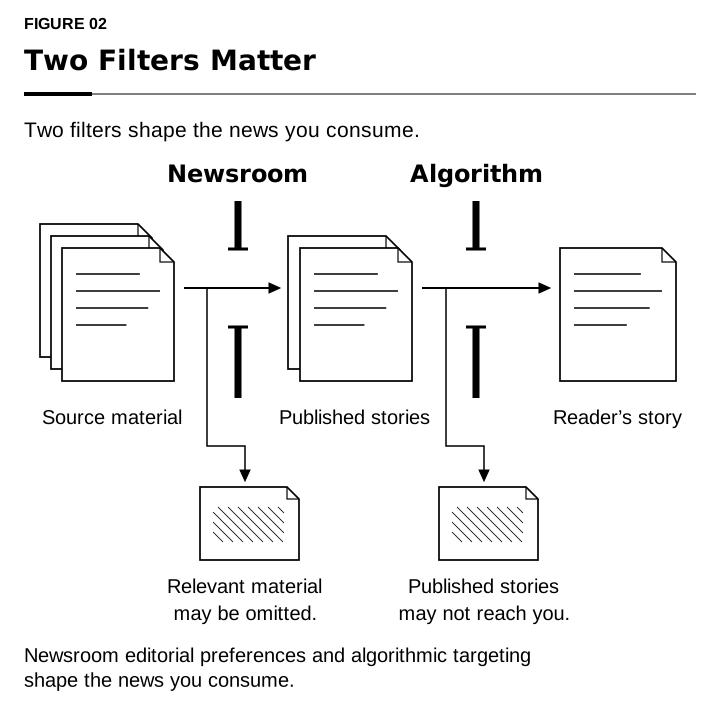
Suppose a factory closes and hundreds of people lose their jobs. A publication whose readers distrust big business leads with the laid-off workers and the executives' bonuses. Another, whose readers worry about the cost of doing business, leads with falling orders and the expense of keeping the plant open. Both can report the facts accurately while giving their readers the explanation they were already inclined to believe.
The question is whether those readers also get the facts that might complicate that explanation. Did the company face serious financial trouble? Could it have kept the factory open? What did the closure mean for the town? When a publication routinely leaves out the context its audience would find uncomfortable, readers get repeated confirmation of their beliefs instead of a fuller understanding of the events. A fact-check of what was published will not uncover what the coverage left out.
 {#fig-02 width=100%}
One story, two audiences
In January 2019, a short video from the Lincoln Memorial showed Nicholas Sandmann, a Covington Catholic High School student wearing a Make America Great Again hat, standing face-to-face with Nathan Phillips, a Native American elder beating a drum. The clip spread with the claim that the students had surrounded and harassed Phillips.1
Longer recordings revealed a third group, unrelated to either the school or Phillips's march, taunting students and passersby. The students responded with chants; Phillips then approached them, saying he hoped to ease the tension. The short clip began after much of this had happened. The fuller chronology undermined the early account of how the encounter began, although interpretations of the behavior remained disputed.2
For one political audience, the encounter could confirm a belief about Trump supporters' cruelty. For another, the early coverage could confirm a belief that the press was determined to attack them. Both were satisfying explanations to circulate before the reporting had caught up. The test for an outlet was whether it gave readers the context that complicated their preferred version, rather than turn the correction into another reason to tell them they had been right all along.
You were right all along
A news outlet can reassure its audience as regularly as a seller reassures a customer. Its coverage may deliver the message without saying “great decision”: you supported the right policy, distrusted the right politician, and understood what others missed. When preserving that reassurance matters more than reporting an unwelcome finding, the relationship becomes a form of sycophancy.
A recognizable audience gives the publication somewhere to begin. Tracking individual readers lets a service refine its estimate of what each person will welcome. The commercial aim is to anticipate what will keep you reading. In the next chapter, we turn to how your reactions are measured and used to make the world fit you almost exactly.